{
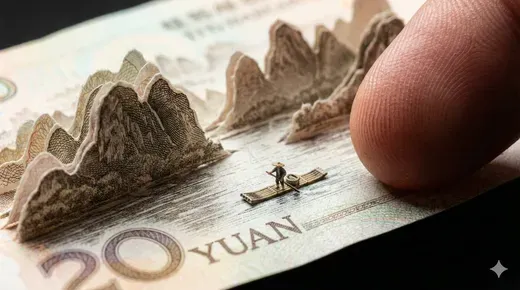
"prompt": "Subject: Genuine Chinese 20 Yuan Banknote (Guilin Landscape edition). \n\n[Macro Material Analysis]: The object must be rendered with the exact physical properties of real currency paper—matte cotton-fiber rag paper, NOT glossy cardboard. \n\n[Paper Engineering]: The karst mountain scenery is delicately cut and lifted. \n- **Critical Thickness**: The cut-out paper layers must appear razor-thin (0.1mm), fragile, and slightly translucent against the light. Edges should show microscopic fibrous tearing, not clean thick cuts.\n- **Printing Texture**: The mountains are NOT solid colors. They must be composed of microscopic engraved lines (intaglio printing) and guilloche patterns. The ink should look slightly raised on the paper surface.\n\n[Scene Context]: A realistic tiny bamboo raft floats on the flat printed water. \n\n[Scale Reference]: A giant, realistic human finger with distinct skin texture presses the edge of the bill. The finger is huge compared to the tiny raft, emphasizing the miniature scale.\n\n[Photography]: Macro lens, high contrast lighting to show the texture of the paper fibers. Shallow depth of field.",
"negative_prompt": "glossy paper, thick cardboard, plastic texture, toy money, monopoly money, solid color blocks, blurred printing, low resolution, cartoon, thick edges",
"aspect_ratio": "16:9"
}
プロンプト (日本語)
{「ヒント」:「件名:20元真札(桂林山水版)」。 n n【マクロ材料分析】:物体は真の貨幣紙の正確な物理特性でレンダリングしなければならない――滑らかな板紙ではなくマット綿繊維のシュレッダー紙。 n【紙工学】:カルスト山景は丁寧に切断され、向上されている。 n-**臨界厚さ*:切断された紙の層は非常に薄く(0.1 mm)、割れやすく、光の下ではやや半透明でなければならない。エッジはきれいな厚切りではなくミクロ繊維の裂け目を表示しなければならない。 n-*印刷テクスチャ*:山脈は純色ではない。彼らはミクロ彫刻線で構成されなければならない(グラビア印刷)とツイストロープのパターン。インクは紙の表面に少し突き出ているように見えるはずです。 n n[シーンの背景]:リアルな小さないかだが平らな印刷水面に浮かんでいます。 n n[スケール参照]:巨大でリアルな人間の指で、独特の肌のテクスチャがあり、紙幣の縁に押し当てられています。小さないかだに比べて指が大きく、マイクロスケールを強調している。 n n n[撮影]:マクロレンズ、高コントラスト照明、紙繊維のテクスチャを表示します。被写界深度が浅い。",「negative _ propt」:「光沢紙、厚紙、プラスチック生地、おもちゃ代、独占金、純色ブロック、ぼかし印刷、低解像度、カートゥーン、厚辺」、アスペクト比:16:9}
クリエイティブの詳細
{「ヒント」:「テーマ:20元人民元真札(桂林山水版)」。 n n[マクロ材料分析]:オブジェクトはサンプルでレンダリングしなければならない。。。